A Day in the Life of a L’Alliance New York Preschool Working Mom
September 20, 2024
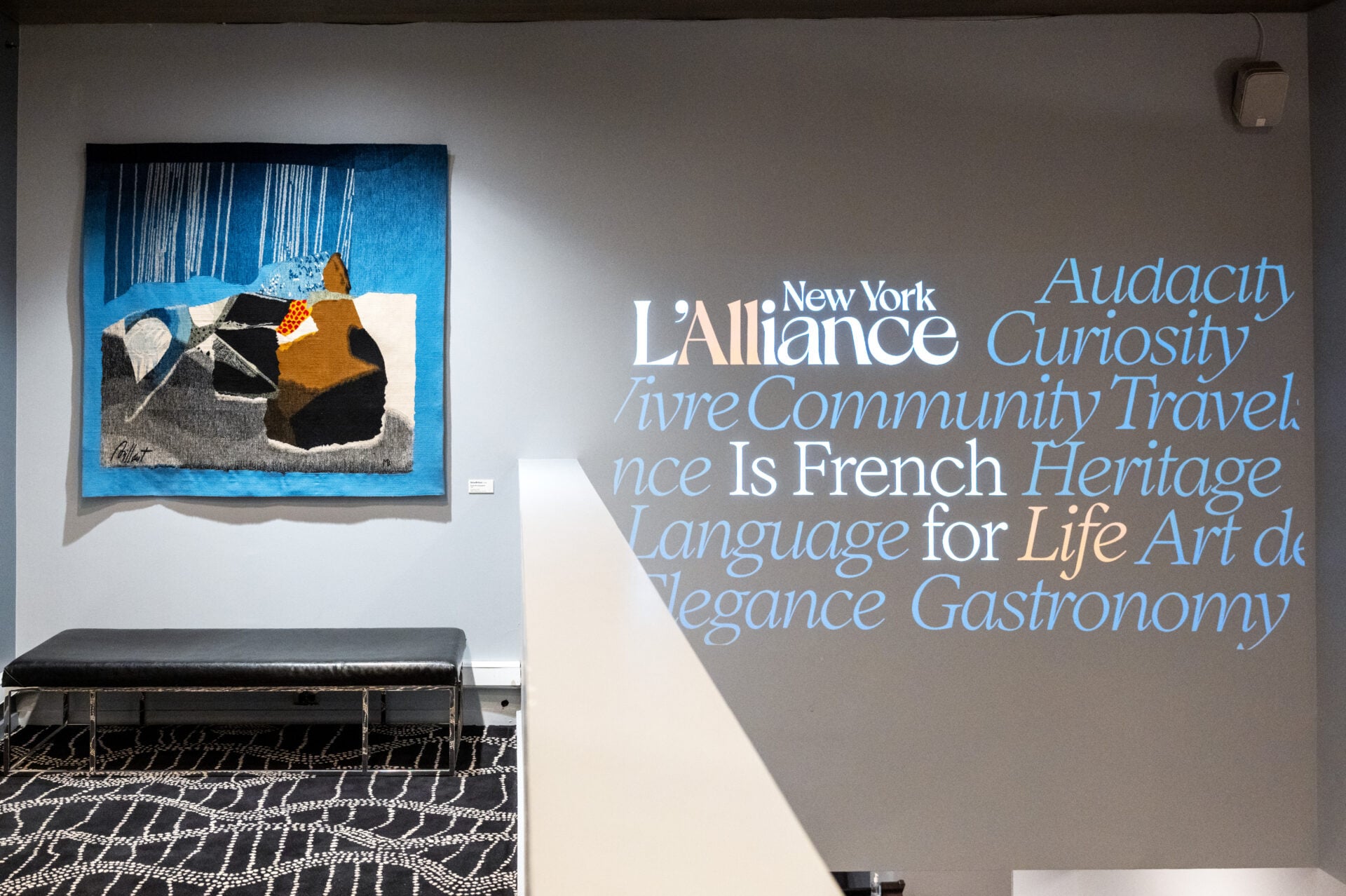
Hervé Lemoine does not waste any time. On Tuesday, he attended the opening of Hidden Treasures, the Comité Colbert’s extravagant exhibition at The Shed, featuring 65 French luxury houses each presenting an iconic object whose sum tells a story between France and the United States. “The Hermès Kelly bag is one example,” Lemoine said as he sat down with us in the Tinker Room at L’Alliance New York. “There is a photograph of the actress Grace Kelly with the iconic bag that had yet to be named after her.”
Hervé Lemoine is the President of Le Mobilier National, a French governmental organization created in the 17th century to initially manage furniture and artworks destined for royal residences. It now falls under the responsibility of the French Ministry of Culture.
At Hidden Treasures, Lemoine showcased a re-edition of furniture created by André Arbus for the French Embassy in Washington, D.C.: the city he headed to after the Comité Colbert opening, to inaugurate the newly redesigned Ambassador’s residence in Georgetown, a tribute to French artisanal and design expertise.
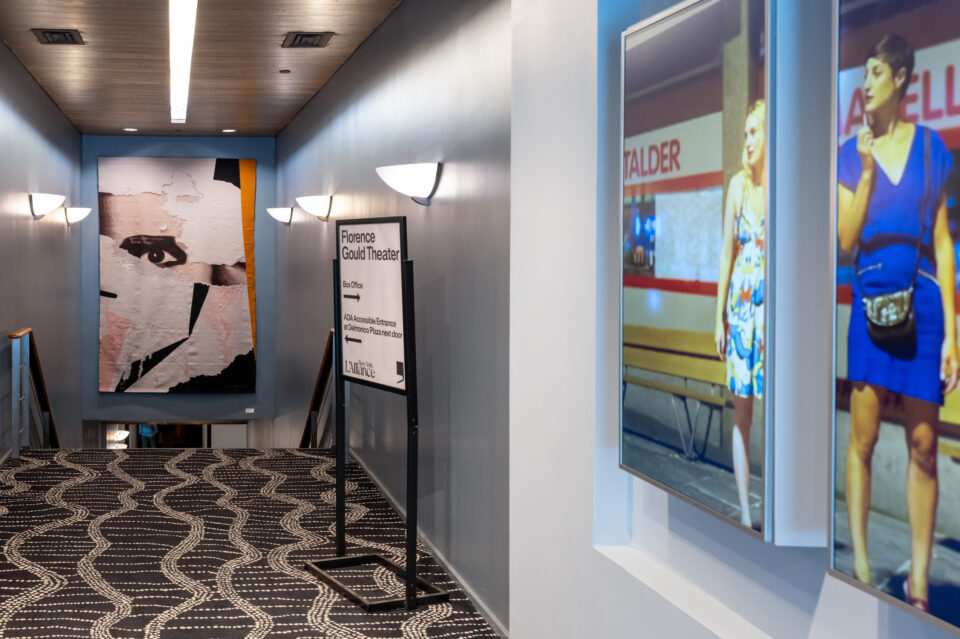
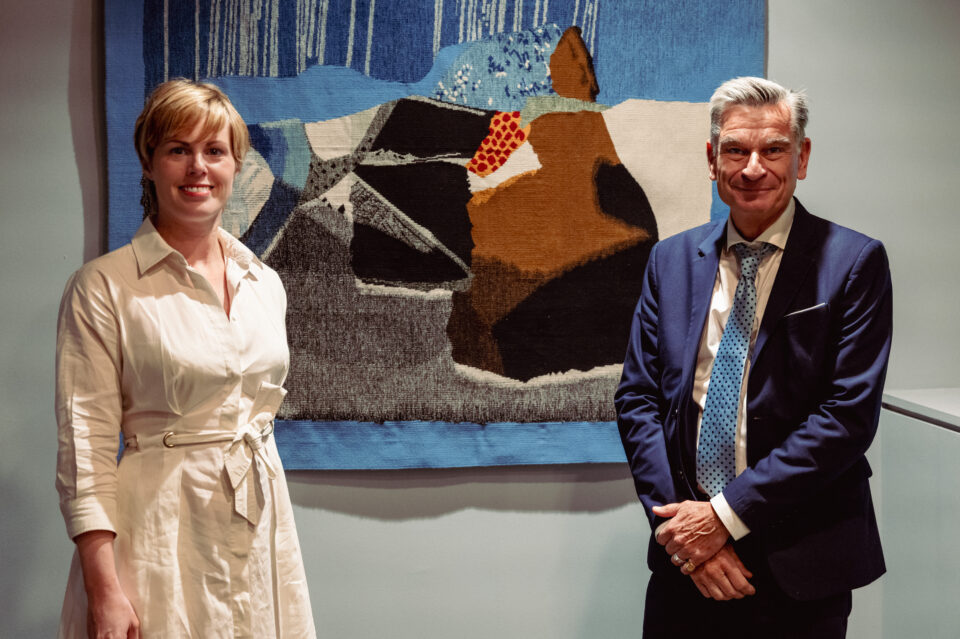
Back in New York, Lemoine raced from Penn Station to L’Alliance New York, and for good reason: two large contemporary tapestries now grace the walls of Florence Gould Hall’s entrance, on loan from Le Mobilier National.
“We are very happy to see this beautiful project at L’Alliance New York, now more than ever a gathering place for the French-speaking world and a showcase for French excellence. It seemed only natural that L’Alliance New York should benefit from loans from the Mobilier National,” Hervé Lemoine said.
The President of L’Alliance New York echoed his words: “The Mobilier National loan is yet another form of cultural dialogue and artistic expression with the New Yorkers who study French at L’Alliance or attend one of our many cultural programs.:”
L’Alliance New York: Why is it important for the Mobilier National to have a presence abroad: in an embassy, an exhibition, or here, in a private cultural and language center like L’Alliance New York?
Hervé Lemoine: Our primary mission is above all to promote and showcase the richness of the craft trades, the expertise, and the fruitful marriage between applied arts and contemporary creation. To carry out this mission, we have long been entrusted with furnishing and fitting out official public spaces. But I believe we must go beyond that. Places of vibrant French cultural expression, like L’Alliance, should also benefit from the dialogue we are trying to establish between the various craft and artisanal traditions. Given its dynamism and singular history, L’Alliance is a true partner in this mission.
L’Alliance New York: How did you decide to choose L’Alliance New York, and these two works in particular?
Hervé Lemoine: When I visited L’Alliance New York, its President Tatyana Franck expressed her wish to redesign some of the spaces to better reflect a message of modernity and creativity. We had never lent works from our collections to this institution. The dynamic Tatyana seized the opportunity, and we began thinking about what kind of intervention to imagine: furniture, rugs, pieces from Sèvres, or works from our historic collections? The idea of hanging contemporary tapestries came to us naturally. From that point on, the choice was difficult because we have hundreds of tapestries.
L’Alliance New York: How did you choose these two?
Hervé Lemoine: There was one practical element: size. There were also the question of the image and the message we wanted to convey. Tatyana Franck chose two works by two women with quite different trajectories. The first is a rather self-taught creator who launched herself into tapestry-making while she was working as a weaver at the Gobelins. She works with collage and photography, exploring the theme of the gaze. We felt that this notion of the gaze, which is also a form of struggle, as the tapestry’s title suggests, was entirely in keeping with the message L’Alliance carries. This tapestry greets visitors as they arrive. It holds an interrogative quality. This gaze is one that invites openness and contemplation of the world in all its facets.
L’Alliance New York: That tapestry is installed where visitors descend the grand staircase past the box office. The second is midway toward Florence Gould Hall.
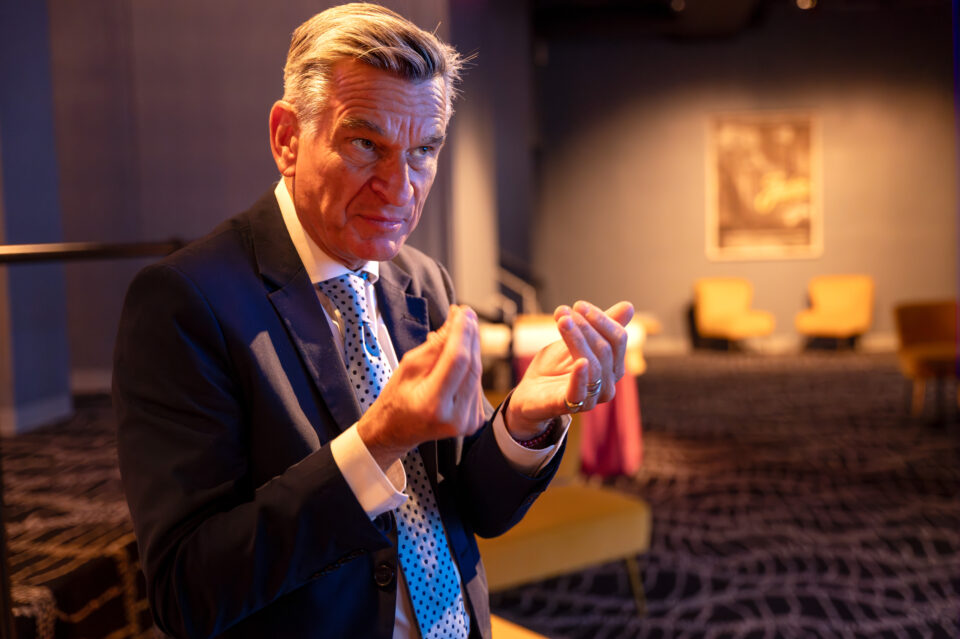
Hervé Lemoine: The other tapestry is a smaller format and the result of a different technique called low-warp weaving (the Aubusson technique, as opposed to the high-warp technique of the Gobelins used for the first tapestry). The artist Gilou Brillant is a woman who was very active in the 1950s and ’60s and gained a degree of recognition in the United States. She produced a great deal of printmaking and aquatints. She was represented by a New York gallery in the 1960s, having made the reverse journey of many American artists.
L’Alliance New York: Two works of art, but also, as you pointed it out, two very different techniques.
Hervé Lemoine: It is precisely this relationship between material, technique, and then spirit, imagination, and creative talent that interests us. Contrary to certain received ideas about contemporary art, it takes years of practice to master the technical skills needed to give a work its power. To be able to present, in this space, pieces that are at once works of creation and speak to a very French tradition of tapestry-making is entirely coherent.
L’Alliance New York: Works from the Mobilier National’s collections on the walls, but also a new atmosphere in the Tinker Room as well.
Hervé Lemoine: This space now benefits from a magnificent carpet by Maison Frey, a very old French house with a savoir-faire widely recognized by American interior designers and decorators. The coherence is there.
L’Alliance New York: And this warm, orange-tinged light, with its gentle shadows. Light is essential here, isn’t it?
Hervé Lemoine: Light brings us back to something Tatyana and I discussed at length. If you want a space to emanate a certain atmosphere, you have to attend to every detail, and light is one of those things that must be treated with great care. It is light that creates an ambiance that expose shapes and colors. Even the display of our tapestries depends on lighting. Everything must come together. We are deeply committed to this idea of the total interior designer.
L’Alliance New York: So, you’ll be back? If only to collect these works…
Hervé Lemoine: And to bring others! It is a five-year loan, but that doesn’t preclude additional loans. Some walls could certainly benefit from interesting new additions, and we can always renew them.
Lead Image (c) JC Agid / L’Alliance New York